 In Lisa Cholodenko's The Kids Are Alright Annette Bening and Julianne Moore play a middle aged lesbian couple — affectionate, bickering, slightly passive-aggressive in that way of new-age couples whose vocabulary outstrips their emotions ("Go easy on the wine honey" Same goes for the micro-managing") — with two teenage kids, played by Mia Wasikowska and Josh Hutcherson, who decide to look up their biological sperm-donor dad. He's played by Mark Ruffalo, in a sequel-performance of sorts to his ne'er-do-well brother in You Can Count On Me: a proud college drop out who has opened his own organic restaurant, he oozes casual, unkempt virility. Ruffalo's great at bringing out the charm of immature boy-men, rough at the edges, with possible a skateboard or two in their closet, who can't quite seem to do the right thing. As in his 2002 film, he becomes instantly attractive to the two kids for his rakish ways: his motorcycle, his pride in his drop-out status, his chill attitude to the uptight decision-makers in the adult world. Chodolenko, who wrote the screenplay with Stuart Blumberg, has done something instinctively smart here: she's taken one of those plots in which a foursquare family, loving but repressed, is loosened up by the incursion of a wild card — but she's swapped the roles. The uptight family is represented by the new-age lesbian couple, hiding their emotions behind hen-pecky emo-talk, and the wild card is an unreformed rake. Is such her film is an affectionate satire, of sorts, on the kind of organic-vegetable-eating, compost-mulching uber-liberal Californian lifestyle she clearly knows inside out: Guess Who's Coing to Dinner, a generation later — which is to say, upside down. It's a oasty-looking and immensely likeable film, full of winning performances. It's been a long time since Bening did comedy — her reaction shot in The American President, when she realises she's insulted the president, is a small masterpiece of scrambling recovery, and maybe my favorite such double-take in the last 30 years of movies. Her Nic, here, is a terrific mama bear who drinks too much and clutches too tightly: comic and hurt and fierce and touching, in quick rotation, in practically every scene. Sometimes, that dexterity shows up visibly, in the manner of recent Bening performances — you can see the actress throttling forward, easing back, her touch almost too exquisite — but not often. Ruffalo's role is a little more schematic than it was in You Can Count on Me; he's more of a liberal pin-up here, and sexier than he's ever allowed himself to be, maybe because he knows his character is due to be taken down a peg or two — you can see instantly he's to much of a kid himself to be a proper father to those kids — but I missed the scene that came next: the one re-establishing his basic, muddled decency. The big surprise for me was Julianne Moore. I've been a bit of a Moore Agnostic over the years for largely physiognomic reason — that odalisque mask of a face seems too inexpressive a tool for an actress of her ambitions — but she delivers beautifully limber, ditzy comic riffs here, particularly during the Plot Development I Shall Not Discuss. She plays a woman so swaddled in the gauze of therapy she can't recognise her most basic drives when they come knocking. For the first time, we see behind the mask and what we see is both touching and funny: blind existential panic. (July 7th) B+
Jumat, 18 Juni 2010
REVIEW: The Kids Are Alright (dir. Cholodenko)
In Lisa Cholodenko's The Kids Are Alright Annette Bening and Julianne Moore play a middle aged lesbian couple — affectionate, bickering, slightly passive-aggressive in that way of new-age couples whose vocabulary outstrips their emotions ("Go easy on the wine honey" Same goes for the micro-managing") — with two teenage kids, played by Mia Wasikowska and Josh Hutcherson, who decide to look up their biological sperm-donor dad. He's played by Mark Ruffalo, in a sequel-performance of sorts to his ne'er-do-well brother in You Can Count On Me: a proud college drop out who has opened his own organic restaurant, he oozes casual, unkempt virility. Ruffalo's great at bringing out the charm of immature boy-men, rough at the edges, with possible a skateboard or two in their closet, who can't quite seem to do the right thing. As in his 2002 film, he becomes instantly attractive to the two kids for his rakish ways: his motorcycle, his pride in his drop-out status, his chill attitude to the uptight decision-makers in the adult world. Chodolenko, who wrote the screenplay with Stuart Blumberg, has done something instinctively smart here: she's taken one of those plots in which a foursquare family, loving but repressed, is loosened up by the incursion of a wild card — but she's swapped the roles. The uptight family is represented by the new-age lesbian couple, hiding their emotions behind hen-pecky emo-talk, and the wild card is an unreformed rake. Is such her film is an affectionate satire, of sorts, on the kind of organic-vegetable-eating, compost-mulching uber-liberal Californian lifestyle she clearly knows inside out: Guess Who's Coing to Dinner, a generation later — which is to say, upside down. It's a oasty-looking and immensely likeable film, full of winning performances. It's been a long time since Bening did comedy — her reaction shot in The American President, when she realises she's insulted the president, is a small masterpiece of scrambling recovery, and maybe my favorite such double-take in the last 30 years of movies. Her Nic, here, is a terrific mama bear who drinks too much and clutches too tightly: comic and hurt and fierce and touching, in quick rotation, in practically every scene. Sometimes, that dexterity shows up visibly, in the manner of recent Bening performances — you can see the actress throttling forward, easing back, her touch almost too exquisite — but not often. Ruffalo's role is a little more schematic than it was in You Can Count on Me; he's more of a liberal pin-up here, and sexier than he's ever allowed himself to be, maybe because he knows his character is due to be taken down a peg or two — you can see instantly he's to much of a kid himself to be a proper father to those kids — but I missed the scene that came next: the one re-establishing his basic, muddled decency. The big surprise for me was Julianne Moore. I've been a bit of a Moore Agnostic over the years for largely physiognomic reason — that odalisque mask of a face seems too inexpressive a tool for an actress of her ambitions — but she delivers beautifully limber, ditzy comic riffs here, particularly during the Plot Development I Shall Not Discuss. She plays a woman so swaddled in the gauze of therapy she can't recognise her most basic drives when they come knocking. For the first time, we see behind the mask and what we see is both touching and funny: blind existential panic. (July 7th) B+

Kamis, 17 Juni 2010


Rabu, 16 Juni 2010
Psycho turns 50? It seems a lot older

"What draws me in is the sheer artistry of its director. That, and those opening scenes with Janet Leigh, her boss and his millionaire sleazebag who get taken for a ride. All of those great scenes with the cop on the road. I love when she brings her money into the bathroom and peels off enough bills to buy her new used car. The film is still good after that – creepy and thrilling. But it is those first moments that make it what it is: a timeless piece of rich, dense, fulfilling cinema. You really don’t get better." — Sasha Stone, Awards Daily
Nyeaah. You don't get any better than Psycho? How about North by Northwest, Rear Window, Strangers on a Train, Notorious, The Trouble With Harry, or To Catch a Thief? I've always thought Psycho one of Hitchcock's weakest films. As Stone rightly says, it basically has the best opening twenty minutes of any Hitchock movie, but there's a reason for that; everyone always praises the radicalism of Hitchcock killing off his heroine in the first reel without mentioning the consequence: the film literally has to start again, halfway through, with a new hero and heroine. It's literally a do-over. The ungainliness of that has never struck me as particularly winning, especially from so beautiful a formalist as Hitchcock. The big clue is that nobody ever gets over this hump without mentioning the "mastery" of Hitchcock, as if the only way to fully appreciate the drama is to be yanked forcibly yanked out of it. (It's the same problem with virtually every frame of Kubrick, but that's another story). Then there's all those cellars and skulls: I've always liked Hitch best when he lets horror unfold in public, in broad daylight — the murder at the U.N. in North by Northwest, or best of all the murder in The Trouble with Harry, which takes place on a crisp fall day — as if to show us that our worst nightmares are waking dreams, from which there is no escape. He practices a rare species of Gothic blanc. Psycho opts for actual dungeons and darkness, as if all the lace-and-candle Gothic accoutrements from Du Maurier's Rebecca had risen to claim him once more. Psycho turns 50? It seems a lot older.
Selasa, 15 Juni 2010
Britain and the oilspill: fighting the last war

"The British media are mightily offended over what they see as anti-British rhetoric in the administration's attacks on BP. My feeling is that the specifically anti-UK element in the U.S. reaction to the oil spill has so far been impressively slight--and far smaller than would be the anti-US reaction in Britain if the case were reversed. Americans seem no angrier with BP than they would be with one of their own oil companies. I don't think they care one way or the other that the firm is British." — Clive CrookIt's truly bizarre, as a Brit living in the US, to witness the British press whining so. As I've said on this blog, I'm absolutely amazed there wasn't a more nationalist flavor to the debate earlier, and I'm still amazed at how mild it is, if it's even existent at all. There doesn't seem to be any anti-Brit feeling coming out of the Gulf. Imagine the uproar if an American company had fouled the coast of Normandy, or the white cliffs of Dover. I suspect a large part of this is residual anger left over from the Bush administration and the way Blair caved over Iraq. The British press are saying to Cameron: here's your chance. Don't do a Blair. They're fighting the last war, as people always do.
Quote of the day: Thelma Schoonmaker

“Like a lady who has lost weight and she’s just getting to that point where she can fit into that favourite dress, you get the film down to just about the right cut. You can feel it when it happens.” — Thelma Schoonmaker on editing a Martin Scorsese film
Bret Easton Ellis: Once More, With Feeling

"Alienation. The sweet sound of excess. A generation caught checking out their reflections in each other’s mirror shades. Such have been the themes if Ellis’s career, going back to his 1985 debut, Less Than Zero, which turned him into a literary star at the age of 22. His new book, Imperial Bedrooms, a sequel to that work, catches up with his cast of jaded Los Angelinos some 30 years later to find them still a little sore at their depiction as inarticulate zombies: “[the writer] floated through our lives, and didn’t seem to care how flatly he perceived everyone... showcasing the youthful indifference, the gleaming nihilism, glamorising the horror of it all.” The book has it’s share of horror, not least a series of gangland slayings, but then dead bodies are to a Bret Easton Ellis novel what Aspidistras are to a George Orwell novel: part of the scenery. More noticeable is the misting of melancholy that enshrouds LA’s billboards and boulevards, and the mysterious crying jags that steal over its hero. “Doesn’t sound like you,” says someone going over his emails. “I mean you could be a cold dude sometimes, but these are actually rather heartfelt and sad.” Feelings? In a novel by Bret Easton Ellis? Whatever will his fans say." — from my interview with Bret Easton Ellis in the Sunday Times
Senin, 14 Juni 2010
So Glad I Don't Have to See: The Killer Inside Me*
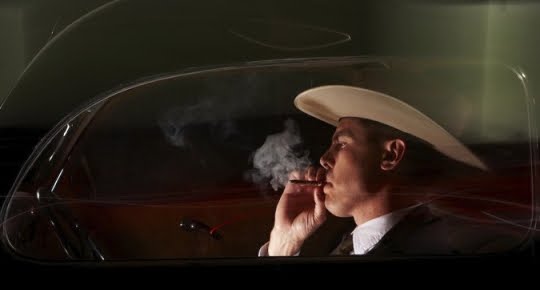
"The Killer Inside Me is a particular distillation of male hate, as practised by repulsive and inadequate individuals who have been encouraged to see themselves as essentially decent by virtue of the trappings of authority in which they have wrapped themselves. And Winterbottom is tearing off the mask; like Michael Haneke, he is confronting the audience with the reality of sexual violence and abusive power relations between the sexes that cinema so often glamourises. Here, the movie is saying, here is the denied reality behind every seamy cop show, every sexed-up horror flick, every picturesque Jack the Ripper tourist attraction, every swooning film studies seminar on the Psycho shower scene." — Peter Bradshaw, The GuardianI've never found the Art card really alters my experience of the movie that much. I get that it alters what you can say the movie is 'saying', but then that's always the least interesting bit of the moviegoing experience. And the experience in this case sounds viscerally unpleasant, whichever way you cut it. It's unpleasant to see a woman getting beaten to death. It's unpleasant when it's shot by a b-movie hack and it's unpleasant when it's shot by an Oscar winning auteur. It's unpleasant when the film is exploitative dreck and it's unpleasant when its artistic credentials are impeccable. I don't care.
*An occasional series devoted to those movies which make me pleased not to be trudging the critical treadmill any more; designed to illustrate the idea that we are all of us reviewing movies, all the time, even the ones we do not see.
Langganan:
Postingan (Atom)